Sapiens & Co

Vector

VectorGrowth system

Vector, the marketing growth system. Growth needs momentum and direction.

Budgets spent, campaigns running, an agency or two on the books - and still no straight answer to the one question that matters: is it actually working? That's what Vector's for.

Anthony Tattum making a point during a workshop
The problem

Why plans drift

Most marketing plans drift. Not because the thinking was wrong on day one, but because things change underneath it. Tactics start running ahead of the diagnosis they depend on, and nobody quite notices until the results do.

1234THE PLANWHAT ACTUALLY HAPPENS
  1. 1Budgets tighten
  2. 2Priorities shift
  3. 3A new stakeholder joins
  4. 4The work outruns the strategy

Vector exists to stop that - not by planning harder, but by making sure every piece of work can always point back to which stage it's actually at.

The outcome

What you get

Three things you have in hand, whatever size the business.

From stage 1

A diagnosis

A clear, evidenced view of what's actually limiting growth - not a guess, and not a template.

From stages 2-3

A strategy

The choices that guide everything after it - who you're for, what makes you distinctive, and where the budget goes.

From stage 6

A way to measure

Built in from the start, not bolted on at the end, so you know whether it's actually working.

Built on

Ehrenberg-Bass · Romaniuk · Google & Ipsos · Binet & Field

See where this comes from →
The loop

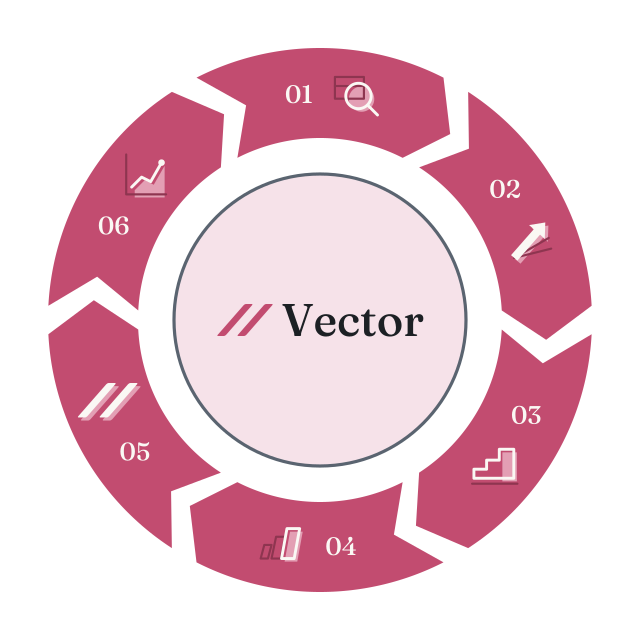
Six stages. One loop. Each one earns the right to the next.

Vector runs six stages in order - diagnose the market, decide the growth opportunity, set the strategy, build memory and momentum, apply the messy middle, then measure and learn - and loops back to the start.

Stage by stage

Stage by stage

Six stages, each with a job to do and something to show for it. Skip one and the next is built on guesswork.

01

Diagnose the market

What's actually going on in your market?

Opinion gets replaced with evidence - who buys in your category, when, why, and who they choose instead. You leave with one shared, evidenced view of category, customers, competitors and demand.

Sets up →The opportunity gets chosen on evidence, not by whoever argues loudest.

02

Decide the growth opportunity

Where will growth really come from?

The possible levers are weighed and one is chosen - the biggest, stated as one thing, not a wishlist. You leave with a growth opportunity statement, a priority focus and a list of what to stop doing.

Sets up →A strategy with a clear target, so every choice after it has something to answer to.

03

Set the strategy

Who are you for, and why should they choose you?

The choices that guide everything after - who you're for, how you're positioned, the buying moments to own and where the budget goes. You leave with positioning, priority buying moments, the distinctive assets to build, budget rules, channel roles and a route to market.

Sets up →Creative and media that pull in the same direction.

04

Memory & momentum

How do you get remembered now, and chosen later?

Two engines built together, not in turn - brand that builds demand over time, and activation that turns it into action now. You leave with a brand plan, an activation plan, a creative playbook and a map of where buyers get stuck.

Sets up →Enough demand to make fine-tuning the buying journey worth doing.

05

Apply the messy middle

What's stopping interested people from buying?

Behavioural science applied where decisions actually get made - less friction, stronger response, used ethically and never as theatre. You leave with the six decision biases from Google and Ipsos's research mapped to your funnel and channels, a test plan and an execution checklist.

Sets up →More of the demand you've built has a clear route to a sale.

06

Measure & learn

Is it working, and what changes?

Measure what matters, keep brand and activation separate, and change decisions on the evidence. You leave with a measurement plan, a review rhythm and a plan for moving budget to what's working.

Sets up →What you learn becomes the next diagnosis. The loop starts again, better informed.

Some outputs start light and fill out as evidence comes in.

The Brand Code

Brand guidelines, evolved.

The Brand Code is a living, machine-readable record of what your brand stands for, who it's for, how it speaks and the rules it runs by. One source of truth for the business, and for everyone and everything that markets it. Because every field is evidenced and kept current, the work stays consistent, and what's learned on one piece of work carries into the next.

Brand guidelines
The Brand Code
A PDF, updated when someone remembers
Living, updated as evidence comes in
Logo, colours, tone of voice
Strategy, audience, language and operating rules
Rarely sourced
Every field sourced, dated and owned
Read by people, occasionally
Read by people and machines, every day
Principles

Five non-negotiables

The stages set the order. These five rules shape every decision inside them - and they're what keep your budget away from some of marketing's most common and costly mistakes.

Diagnosis before tactics

No money goes on channels or creative until everyone agrees where growth will come from. It can feel slower at the start, but it usually saves far more time than it costs, because the work is pointed the right way from day one.

Long and short work together

This quarter's sales and next year's demand are built at the same time, not traded off against each other. Cut the long-term work to hit a short-term number and the pipeline tends to thin out further down the line.

Availability first

More growth tends to come from being easy to think of and easy to buy than from clever persuasion. That means reaching more of the people who could buy, and being the name they remember when they're ready.

Behavioural science for execution

People rarely buy the way they say they do. Behavioural science is used where decisions actually get made, to make the next step easier and the reason to choose you clearer. Applied honestly, never to trick anyone.

Measurement that prevents self-deception

Measure what moves the business, not what flatters the report. Brand and short-term results are tracked separately so one never hides the other, and every review ends with a decision about what to change.

How it starts

How it starts

Two ways in, depending on where the business is. Both end the same way: a clear, evidenced plan for the next 90 days.

For established businesses with a team, a budget and data to work with

The Vector Diagnostic

Conversations with the people who matter, a first look at the numbers and an honest scorecard of where you stand. Then a workshop to agree what the evidence says, and a playback you can take to the board.

InterviewsData packScorecardWorkshopPlayback90-day plan

You leave witha 30-60-90 day plan.

Start with the Diagnostic →

For early-stage and pre-launch businesses

Vector Launch

The same discipline, lighter touch. Founder and team conversations rather than a formal interview programme, a hands-on audit of the product or site, and existing materials tested against evidence instead of taken on trust.

You leave witha focused plan for the first 90 days.

Start with Launch →
Questions

Questions people ask about Vector

The things that usually come up in a first conversation.

Something not covered? Get in touch →
How is this different from what an agency does?

An agency does the work. Vector decides which work, in what order, and whether it's working. It sits above the channels, so the effort you're already paying for points at the same target - and you can tell when it's hitting it.

Does it work for a smaller business?

Yes. The six stages hold for every business, in the same order. What changes is how long each one takes. A smaller business with a clear, narrow opportunity can move through the early stages quickly; a larger or more complex one needs more time in the same places. The structure doesn't scale down. The depth does.

Do we have to start at the beginning?

Yes - but if you already have good evidence, the first stage moves quickly. Starting anywhere else means building on assumptions, which is how most plans drift in the first place.

What happens to our existing agency or team?

They stay. Vector gives them clearer direction and one brief to work from, so their effort goes further.

Where does AI come in?

AI speeds up the research, drafting and analysis, so more of the time goes on thinking rather than admin. The judgement - and the accountability for it - stays with me.

Is it based on anything, or did you make it up?

Both, and that's the point. Vector draws on published marketing science: Ehrenberg-Bass and Byron Sharp on how brands grow, Jenni Romaniuk on distinctive assets, Google and Ipsos's research on how people decide, Andrew Chen on winning one community before expanding, COM-B and EAST for behaviour change, and Binet and Field on balancing brand and activation. What's mine is the order of the stages, the rule that each one earns the right to the next, and the discipline of the Brand Code, where every field carries a source, a date, a confidence level and an owner.

Not sure if Vector's the right fit?

Tell me what you're trying to grow. I'll tell you honestly where Vector would help - and where it wouldn't.

Get in touch