AI search has two halves: the facts you control, and what people say about you. The evidence suggests the second matters more - and it's the harder one to earn.
In June I spoke at the CIPR Midlands PR Conference. I opened with a line borrowed from a book: tech is changing, humans aren't.
Five months on, it's holding up better than most of my predictions.
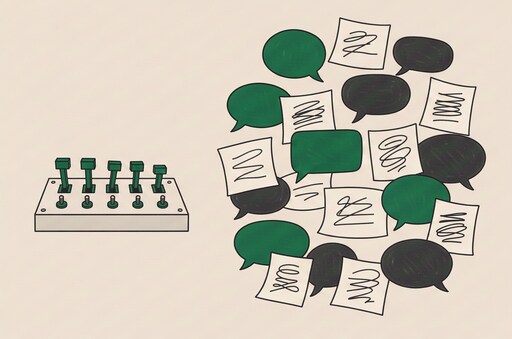
WARC has a useful way of splitting AI search into two halves.
Levers are the things you control. Your schema, your Google Business Profile, your Wikipedia entry if you have one, your product feeds, the facts on your own site.
Drift is what people say about you. Reviews, forums, Reddit threads, trade press, conversations on LinkedIn. You can guide it. You can't buy it.
Early citation research suggests drift carries more weight. WARC's own summary of the latest attention thinking fits in five words: AI recommends what people remember.
That shouldn't surprise anyone. The models learned from us. They read what people wrote, so they inherit what people noticed, discussed and remembered.
Charlie Oscar's study for WARC followed 30 brands across six categories for eight months. It put 63% of a brand's visibility in AI answers down to long-term brand equity. Wider marketing activity accounted for 22%, citations 11%, and PR and influencer reach 4%.
It's one study, and it's early days. But the direction matches decades of evidence on how brands grow.
Being cited isn't the same as being chosen, either. Skyword's research this month found only 26% of people remembered the company or product name after using AI to research a purchase.
Then there's the cost of going quiet. Ehrenberg-Bass has shown for years that brands which stop advertising lose share steadily - around 10% after a year, 20% after two. New work reported by WARC this month suggests the loss starts within a single quarter.
Herbert Simon won a Nobel prize for showing that we don't maximise. We satisfice - we take the first option that's good enough and stop looking.
Asking an AI "who's the best X near me?" is satisficing with a nicer interface. One question, one answer, done. If you're not in the answer, there's no page two to fall back on.
What puts you in the answer is what has always put a brand on a shortlist: being easy to think of when the need arrives. Byron Sharp calls it mental availability. Most of your buyers aren't in market today. The job is to be remembered by the ones who will be.
For a founder-led business, I'd split the work the same way WARC does.
Fix the levers. They're cheap.
Most of this is an afternoon's work, done properly once.
Earn the drift. It takes longer.
When I said this to a room of PR people in June, the line that landed was: your earned media is your GEO. (GEO is generative engine optimisation - being the brand an AI names.) The craft PR teams have practised for a century turns out to matter more, not less.
I've spent part of the last few weeks on the levers for my own business. Directory listings, one description at a time, character counts and all. It is not glamorous.
I also renamed the business the week before launch, which is exactly the kind of inconsistency I tell clients to avoid. So I'm doing the tidy-up I'd recommend to anyone.
The levers make sure you're described correctly. Only the drift gets you chosen.
Tech is changing. Humans aren't. That's still the good news.


New · Free playbook
Brand is back on the board agenda. This is the evidence for why, and a six-stage, 100-day plan to act on it, for PE-backed, VC-backed and founder-led businesses.