Brand or performance marketing? The evidence says both. Why brand is back on the board agenda for scale-ups and investor-backed businesses.
I've sat in a lot of board meetings where the marketing report looked healthy. Clicks up, cost per lead steady, a packed content calendar. And quietly, the growth engine was stalling.
It's a familiar pattern. A business grows on the founder's network, good word of mouth and a lot of hard work. Then it hires for performance marketing - paid search, paid social, retargeting - because performance marketing can be measured. Every pound gets pointed at people who are ready to buy right now.
The trouble is that, at any given moment, not many people are. That's true whether you sell software, recipe boxes or professional services. The Ehrenberg-Bass Institute's rule of thumb for B2B is that around 5% of a market is actively buying (I've written more on the 95:5 rule); in most consumer categories, outside the weekly shop, it's a minority too. And when people do start looking, most choose from brands already in their head. McKinsey found that brands in a consumer's first shortlist can be up to three times more likely to be bought. Bain & Company reports that around 90% of B2B buyers end up buying from a supplier on their Day 1 list.
So you can be very good at catching the few who are ready and still lose. If you weren't on the list before the search started, no amount of retargeting will put you there. You end up competing harder, and more expensively, for the same small pool. The cost of each new customer creeps up. Discounts creep in. Growth slows, and nobody can quite say why.
That's why more and more chief executives and finance directors are talking about brand again - not as a cost to trim, but as an investment that shows up in the numbers.
Brand isn't a five-year bet. In Les Binet and Peter Field's analysis of the IPA's effectiveness data, brand building overtakes short-term sales activity as the main driver of growth after about six months. Before then, the early signs move: awareness, consideration and share of search - searches for your brand as a share of searches for your category - which tends to run ahead of market share. And because memory builds on memory, the effect compounds.
Take Gousto. In 2018 the recipe box company was a VC-backed scale-up up against a better-funded rival, and around 80% of its new customers came through performance marketing. It chose to build the brand instead of outbidding the competition for clicks. By 2021, Marketing Week reported that 82% of sign-ups came organically or through referral. Gousto's IPA Effectiveness Awards paper reports net revenue up four-fold from 2019 to 2024 and marketing return on investment up 232%. Lockdown helped, and not all of that is down to brand. But the shift in where customers came from is the point: paid-for growth became growth that largely pays for itself.
The biggest pay-off is often in price. When McCain backed its brand against supermarket own label, the IPA's 2024 Grand Prix winner, the average price paid rose 48% per kg and price sensitivity fell 47%. The effect on price was roughly five times the effect on volume. For a PE-backed business watching gross margin, that's the number that matters.
And it's the bit most measurement misses. Thinkbox and Ebiquity's Profit Ability 2 study looked at £1.8bn of UK advertising across 141 brands. Measured over the short term, the average profit return was £1.87 for every pound spent. Measured over two years, it was £4.11. And 58% of the profit arrived after the first 13 weeks - which is often where the reporting stops.
Most of this evidence started with consumer brands. LinkedIn's B2B Institute then asked whether it holds in B2B, and Binet and Field found the same rules broadly do. It's a small sample, and they're careful to call the findings tentative, but the pattern is familiar. Brands that spent more on advertising than their size suggested tended to grow. Campaigns that reached the whole market beat campaigns aimed only at existing customers. And campaigns that built the brand made sales activity work harder too.
Most marketing arguments in growing businesses end up as brand versus performance. It's the wrong argument.
Activation - the ads, offers and follow-ups aimed at people ready to buy - converts demand that exists today. It's quick, measurable and fades as soon as the spend stops. Brand building - making you known, liked and easy to think of - builds the demand that comes next. It takes a few months to show, then compounds. Mark Ritson calls holding both at once "bothism". It's a good word for a simple idea: they do different jobs, and each makes the other work better.
Binet and Field's work suggests a starting point of around 60% brand to 40% activation for consumer businesses, and closer to 46:54 in B2B. Most growing businesses I see are nowhere near either. Nearly everything goes on activation, because it's easier to report on.
What that means depends on who's round the table.
A fair warning. McCain had a decade and a TV budget, and even Gousto had serious funding behind it. A £20m scale-up won't reproduce that, and shouldn't try. The scale doesn't transfer. The principles do.
Evidence is only useful if it changes the decisions you make. The approach I use with clients runs in six stages, in order, as a loop:
The order matters. Most businesses jump straight to stage four - a new campaign, a new website, a new agency - without agreeing where they're competing, who they're up against, who they most want to win and why those buyers should choose them.

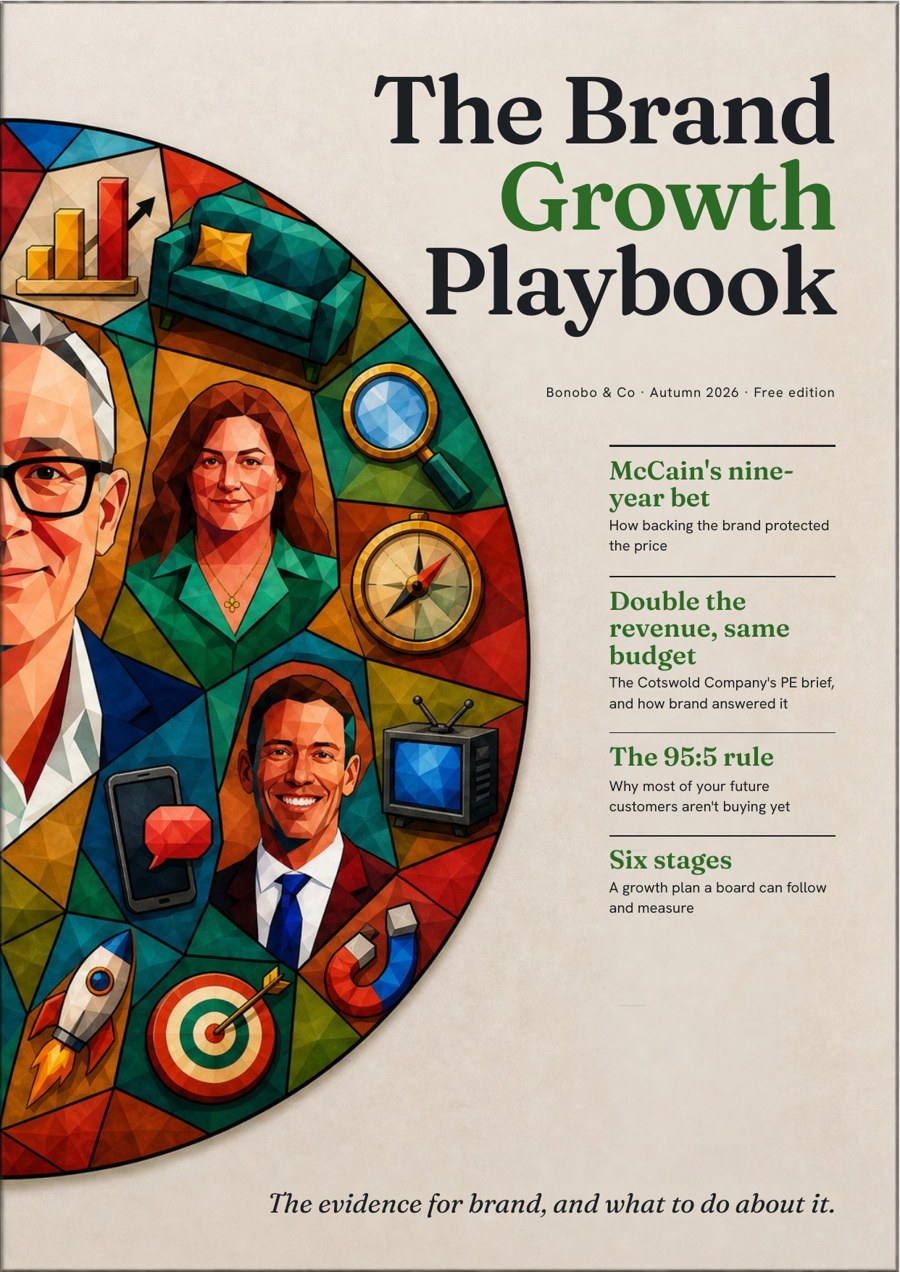
I've written it all up in The Brand Growth Playbook: the evidence, what it means for PE-backed, VC-backed and founder-led businesses, and what to do in the first 100 days at each stage, with a number the board can watch. It's free, and you can download it now.
Get The Brand Growth Playbook →

New · Free playbook
Brand is back on the board agenda. This is the evidence for why, and a six-stage, 100-day plan to act on it, for PE-backed, VC-backed and founder-led businesses.